Winning the Race Through Real-Time Data and Seamless Team Integration


I was recently watching some behind-the-scenes footage of Charles Leclerc discussing the Ferrari partnership with HP, and it struck me how much the world of Formula 1 mirrors the high-stakes environment we navigate in the business world every day. We often look at the driver-the person in the cockpit-and assume the victory is solely in their hands. But as Charles pointed out so eloquently, the car’s speed is only one piece of a much larger, more complex puzzle. It reminded me of a conversation I had with a colleague over coffee last week about how we often overcomplicate “success” when it really boils down to a few fundamental pillars: strategy, data, and the invisible threads that connect a team.
The Power of the Remote Garage
One of the most fascinating insights Charles shared was the role of the “remote garage.” While he is out there pulling G-forces and hitting apexes at 200 miles per hour, there is a literal army of engineers back at base working on incredibly powerful devices, crunching numbers in real-time. This isn’t just about having a fast computer; it’s about the ability to process massive amounts of data at a speed that matches the pace of the track. In our world, we might not be dodging walls at Monaco, but the pressure to make quick, data-driven decisions is just as intense. If your “remote garage”-your back-office systems, your analytics tools, and your support staff-isn’t equipped with the right technology, you’re essentially racing with a blindfold on.
I’ve seen this play out in various projects at inEvidence. We talk a lot about the “dream work,” but that only happens when the technical infrastructure is robust enough to handle the weight of our ambitions. Charles emphasized that strategy is an incredibly important part of the race, but strategy without real-time data is just a guess. When you have engineers using powerful HP devices to identify problems and solve them in seconds rather than hours, you gain a competitive edge that is impossible to replicate through sheer willpower alone. It’s about the synergy between the human brain and the silicon chips that support it.
“When things are integrated well, the performance just gets better, and that’s what brings you to the top. A great pit stop can help you win the race.”
Synchronization: The Heart of Precision
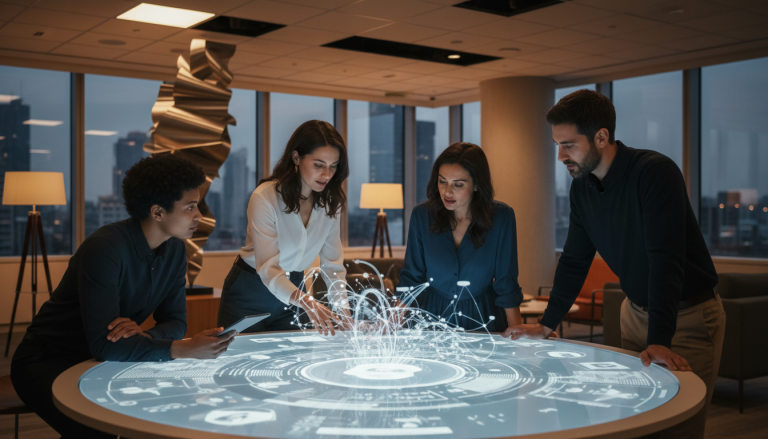
There was a moment in the interview where Charles talked about the “unexpected.” In racing, as in business, you are constantly fighting against competitors who are trying to surprise you with every choice they make. You can have the best plan in the world, but the moment the lights go out, everything can change. This is where synchronization becomes your greatest asset. Charles mentioned that for everything to work perfectly, every part needs to be in sync-the driver, the pit crew, the engineers, and the devices. If there is a lag in communication or a glitch in the data flow, the whole system collapses. It’s a delicate dance of efficiency, precision, and speed.
I often think about our own internal processes in these terms. Are we in sync? Or are we working in silos where the “data” stays trapped in one department while the “driver” is making decisions based on old information? The goal is to reach a state where the synchronization is so seamless that it becomes invisible. When the engineers are in sync with the devices, and the devices are delivering insights at maximum speed, that’s when the magic happens. It’s not just about solving problems; it’s about identifying them before they even become hurdles. That proactive stance is what separates the podium finishers from the rest of the pack.
“It’s all about making everything work at maximum speed, and that’s definitely what HP can offer to the team.”
Applying the F1 Mindset to Business
So, how do we take these lessons from the Ferrari paddock and apply them to our own professional lives? It starts with looking at our tools not as overhead, but as performance enablers. Charles was very clear that HP offers the speed and reliability necessary to keep the team on point. In a business context, this means investing in the technology that allows your team to communicate and analyze without friction. If your team is bogged down by slow systems or fragmented data, you’re essentially asking them to win a Grand Prix in a go-kart. You have to give your people the “powerful devices” they need to do their best work.
Furthermore, we need to embrace the idea of the “pit stop” in our workflows. A pit stop is the ultimate expression of teamwork and precision. It’s a few seconds of intense, coordinated effort that can determine the outcome of an entire hour-long race. In our offices, these are the moments of crisis or the tight deadlines where everyone needs to drop what they’re doing and move in perfect harmony. If you haven’t practiced that synchronization, and if you don’t have the technological backbone to support it, those “pit stops” will be your downfall rather than your advantage. We need to strive for that level of maximum speed in everything we do.
“Whenever there’s this synchronization with absolutely everybody… and the devices we use are in sync, that’s where the dreams happen.”
At the end of the day, whether you’re driving a Ferrari or leading a marketing team, the principles remain the same. You need a clear strategy, you need real-time insights, and you need a team that is perfectly in sync with the technology they use. It was inspiring to hear Charles Leclerc speak about this because it reminds us that even at the highest level of sport, success isn’t just about individual talent. It’s about the ecosystem you build around that talent. It’s about making sure that every part of the machine-human and digital-is working at its absolute limit to push the boundaries of what’s possible.
I’d love to hear your thoughts on this. How are you ensuring your team and your technology are in sync? Are there areas where you feel like you’re racing with a “remote garage” that needs an upgrade? Let’s keep the conversation going, because as Charles says, when everything clicks together, that’s what makes the dream work.