The Trust Shift: Navigating Customer Advocacy in the Age of AI





A few weeks ago, I sat in on a planning call where someone said, “At least AI has finally solved our customer content problem.” I knew what they meant. Faster quotes. More videos. Less manual work. But my gut tightened, because I’m seeing the opposite play out every day. The real challenge in customer advocacy right now isn’t speed. It’s trust.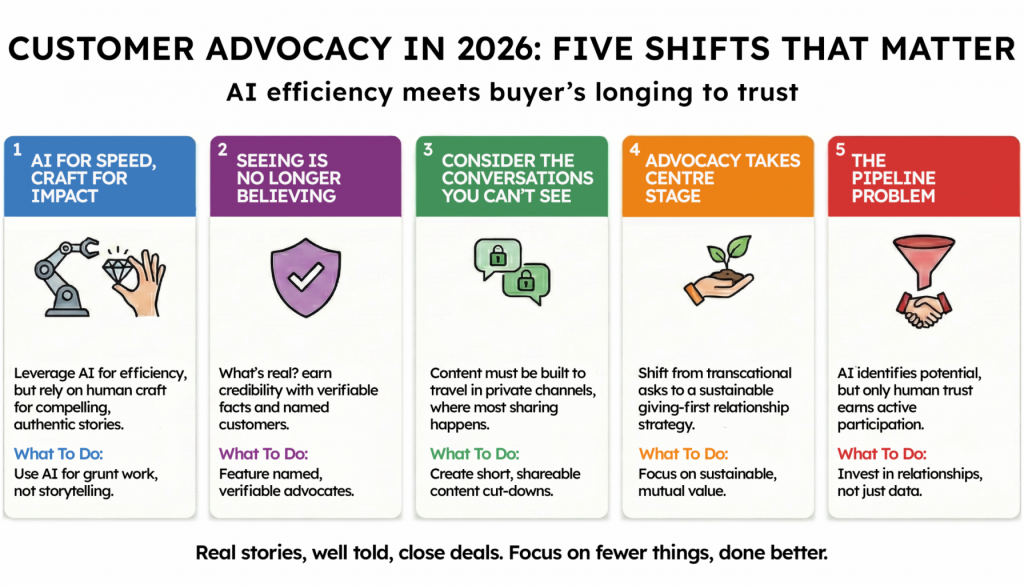
AI can do the work, but it can’t do the believing
There’s no denying how powerful the tools have become. AI can scan call recordings, spot positive sentiment, draft testimonials, even spin up video content that looks polished enough to publish. As someone who has spent years turning raw interviews into stories, I find parts of this genuinely exciting. It removes a lot of the grunt work that used to slow teams down.
But here’s the hard truth: speed without credibility is just noise. We’re drowning in content that looks fine, sounds plausible, and leaves no impression at all. Buyers know it too. They’re savvier, more sceptical, and far more aware of what AI can fabricate. When everything is fast, “fast” stops being impressive.
The teams getting this right aren’t handing the whole process over to machines. They’re using AI to do what it’s good at – identifying potential advocates, creating rough drafts, tailoring formats – and then investing the saved time into craft. That means skilled interviewers who create a great experience for customers, and editors who can turn something technically accurate into something human and memorable.
Faster isn’t better. Better is better – and that still takes care, skill, and judgment.
Seeing is no longer believing, and that changes everything
For years, video was the gold standard of proof. A real customer, on camera, telling their story felt almost unarguable. Today, that assumption is cracking. We all know faces, voices, and even entire scenarios can be fabricated. As a result, buyers are questioning things they used to take at face value.
This doesn’t mean video is dead. It means credibility now runs deeper than the format. The stories that resonate are grounded in specifics: named customers, real companies, concrete outcomes, and context that can be checked. People who exist beyond the asset itself, who show up on LinkedIn, who are willing to stand behind what they’ve said.
What I’m seeing work best is a return to substance. Clear detail beats glossy production. A believable story beats a beautiful one. When customers are open, specific, and visible, the medium becomes secondary. Trust comes from knowing there’s a real person on the other side, not just a convincing image.
In a world where anything can be generated, credibility comes from what can be verified.
Advocacy is moving into places we can’t measure
One of the biggest shifts in the last year has nothing to do with technology at all. It’s where decisions are happening. Research suggests most content sharing now takes place in private channels – Slack, WhatsApp, LinkedIn messages – not public feeds. And with Millennials and Gen Z making up the majority of B2B decision-makers, peer recommendations carry more weight than polished marketing ever could.
This has huge implications for customer stories. If your best advocacy content only lives on your website, it’s not travelling to where decisions are being shaped. The stories that work now are designed to be forwarded. Short, specific, easy to share, and strong enough to stand on their own when someone sends a link with “worth a look.”
It also requires a mindset shift. Some of the most effective advocacy today happens out of sight, without neat attribution or clean metrics. That can feel uncomfortable for teams used to dashboards and direct ROI. But trust has always grown in conversations, not campaigns. We’re just being reminded of that now.
If your customer stories don’t travel well, they won’t show up where decisions are made.
From extraction to investment: what advocacy really means
As retention takes centre stage for more organisations, advocacy is finally being recognised as core work, not a marketing side project. But many programmes still stumble because they start with the wrong question. “What can we get customers to do for us?” leads to short-term wins and long-term fatigue.
Real advocacy starts with investment. At inEvidence, we talk about this through the SANE framework: Status, Access, Networking, and Education. Give customers visibility. Give them access to people and ideas. Connect them with peers. Help them grow. When customers feel valued and supported, participation stops feeling like a favour and starts feeling natural.
This also addresses what I see as the biggest bottleneck right now: participation. Tools can identify potential advocates, but they can’t earn permission. A positive comment on a call isn’t consent. A happy customer isn’t automatically a visible one. The gap isn’t data; it’s trust, built over time through respectful, human relationships.
The strongest advocacy programmes give first, ask later, and last longer because of it.
I don’t believe the fundamentals of customer storytelling have changed. Real stories from real people still work. What’s changed is the context: tighter teams, warier buyers, and an overwhelming flood of forgettable content. The teams that will win in 2026 are the ones willing to slow down where it matters, do fewer things better, and put trust back at the centre of their work. That’s not the easy path, but it’s the one that still works.